
ArenaGear University · Athlete Safety
Laser Timing Gates for Sports: Why Eye-Safe Infrared Is the Better Choice
Many popular timing systems fire a Class 3R laser across the field. ArenaGear gates don't use lasers at all. Here's why that matters for your athletes.
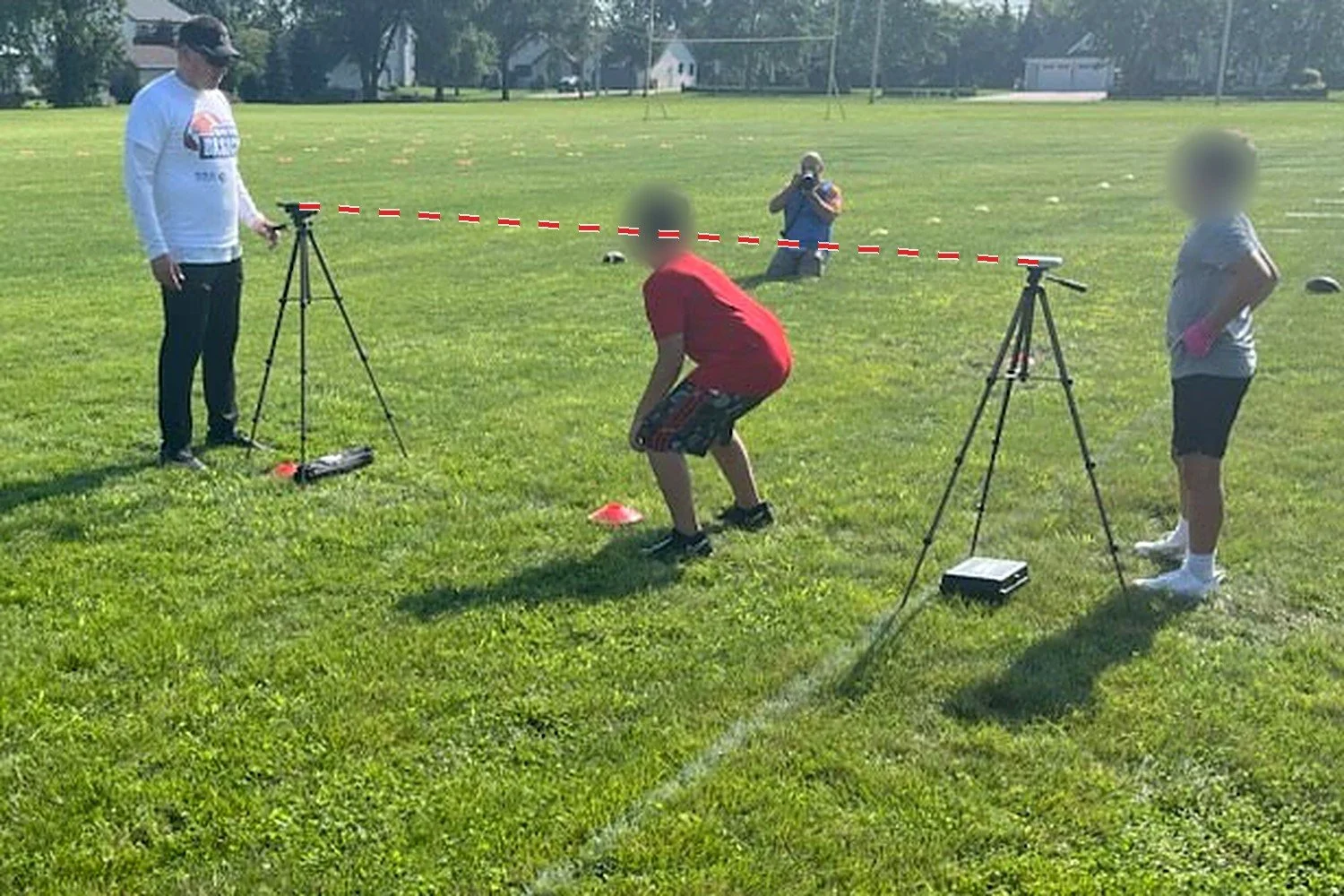
Photo above: The 5-10-5 start: the athlete's face is directly in line with the timing beam. With a laser gate, that's exactly the direct viewing the warning label tells you to avoid.
Coaches search for "laser timing gates for sports" because that's the phrase the market uses. You see it on product pages, reseller listings and forum threads. So when you go shopping, it's the term that gets typed into the search bar.
Here's the part most buyers never hear: many popular sports timing systems use lasers that are not eye-safe. They fire a Class 3R laser beam across the field at the height of kids, athletes and coaches, and those units carry laser warning labels for a reason. ArenaGear gates don't use lasers at all. They use eye-safe infrared.
Are sports timing gates actually lasers?
Many of them are, and that's the problem. Sprint, agility and drill timing systems use two main technologies:
- Reflective laser units, which typically fire a Class 3R laser across the lane and bounce it off the athlete's legs or a reflector mirror.
- Infrared beam gates, which send an eye-safe infrared beam from an emitter to a receiver. It's the same kind of invisible, eye-safe infrared light a TV remote control uses.
Class 3R lasers are not classified as eye-safe. Only Class 1 lasers are considered eye-safe under normal use. ArenaGear gates are eye-safe infrared: no laser, no warning label, no risk to the athletes standing next to them.
Because "laser timing" gets used loosely as shorthand for any electronic timing gate, many coaches don't realize they've bought a real laser until they see the warning sticker on the unit. Always check the spec sheet for the light source and, if it's a laser, its laser class.
Why the difference matters on a real field
You're not timing one athlete in a controlled lab. You're running a 40-yard dash with a whole position group, a shuttle drill with twenty athletes rotating through, or a combine with hundreds of athletes in one afternoon. People stand next to the gates. They crouch beside them. They walk right through the beam line. Younger athletes, especially, are curious and get close.
Class 3R lasers are not eye-safe. Looking directly into the beam can injure the eye, which is why these products carry laser warning labels and caution against direct viewing. That's a real risk on a field full of young athletes, and a risk you shouldn't have to manage at practice.
The 5-10-5 problem
Take the 5-10-5 pro agility shuttle, a staple of every football combine. The athlete starts in a low three-point stance straddling the line, then sprints, touches and changes direction back through the gate line. At the start, the athlete's face is directly in front of the timing beam. If that beam is a Class 3R laser, the athlete is looking straight into it, rep after rep, which is exactly the direct viewing those warning labels tell you to avoid. With an eye-safe infrared gate, there's nothing to worry about.
How ArenaGear times an athlete
ArenaGear gates use an eye-safe infrared beam that travels gate to gate, paired with a smartphone or tablet app. The numbers coaches care about:
- Accuracy to 1/1000 of a second (0.001 s)
- Timing for sprints and drills up to 600 meters
- 1-gate and 2-gate events, so you can run starts, splits and finishes from one kit
- Fully wireless: no cables down the lane
- iOS and Android app control
- Up to 80 hours on AA batteries
- TEAMS, our free cloud data management service: unlimited athletes, no subscription, no per-athlete fees
- 3-year warranty, made in McKinney, Texas
Setup is a one-person job that takes minutes: stand the start and finish gates on their tripods at waist height, power them on, open the app and run the drill. The gates are self-aligning, so there's nothing to aim. Because the beam goes gate to gate instead of bouncing off the athlete, detection stays reliable across a 10+ ft lane.
Does infrared give up accuracy?
No. Both technologies can time to a thousandth of a second. Where systems differ is how consistently they trigger. Reflective laser units mounted at ground level trigger off a foot or shin, which changes with every stride. A waist-height infrared beam triggers near the athlete's center of mass, so the same run produces the same number.
Six questions to ask before buying any "laser" timing system
- What is the light source, and is it eye-safe? If it's a laser, ask for the class. Class 3R is not eye-safe.
- What is the accuracy? Look for 0.001 s stated up front.
- Are there subscriptions or per-athlete fees? This is where cheap hardware gets expensive. ArenaGear's TEAMS is free, with $0 roster fees.
- How much setup is involved? Self-aligning wireless gates save you the worst part of timing.
- Where is it made, and what's the warranty? ArenaGear: McKinney, Texas, 3 years.
- What can it do with the data? Can you enter a roster and put a different athlete's name on each rep? Can you load a whole class at once, keep events separate from training, and export more than a plain list of times? Is there a real-time API for event organizers and franchises? Some systems can't even take a roster. ArenaGear's free TEAMS does all of this. See how TEAMS handles rosters, classes and exports and the real-time API.
The bottom line
The gates you want on your field are eye-safe infrared, not Class 3R lasers. Before you buy any "laser timing gate," find out exactly what kind of beam it fires at your athletes' eyes.
RM-510 System + Vertical Jump: $798
Free shipping · Eye-safe infrared · No subscriptions · No per-athlete fees · Made in McKinney, Texas
SHOP THE RM-510← Back to ArenaGear University · Compare ArenaGear vs Dashr Silver